🌱 The Regenerative Turn — From Mechanical Care to the Care of Living Systems
Healthcare was built on the logic of machines: diagnose the fault, repair the part, restore function. But living systems don’t heal the way machines do. They adapt, reorganize, and respond to meaning, safety, and context. This reflection explores the regenerative turn in pain care—away from fixing parts and toward supporting living systems, where healing emerges through trust, agency, and relationship.
Healthcare was built on the logic of machines: diagnose the fault, repair the part, restore function. But living systems don’t heal the way machines do. They adapt, reorganize, and respond to meaning, safety, and context. This reflection explores the regenerative turn in pain care — away from fixing parts and toward supporting living systems, where healing emerges through trust, agency, and relationship.
🛠️ The Mechanical Illusion — Why We Keep Treating Chronic Pain Like a Broken Machine
Modern pain care is still dominated by a powerful metaphor: the body as a machine. When something hurts, we assume a part must be broken, worn out, or in need of repair. But chronic pain rarely behaves like a mechanical failure. This reflection explores how machine thinking narrows understanding, fuels fear, and quietly undermines healing—and why living systems require a very different kind of care.
Modern pain care is still dominated by a powerful metaphor: the body as a machine. When something hurts, we assume a part must be broken, worn out, or in need of repair. But chronic pain rarely behaves like a mechanical failure. This reflection explores how machine thinking narrows understanding, fuels fear, and quietly undermines healing—and why living systems require a very different kind of care.
🌀 What Pain Sufferers Can Learn From Socrates
Socrates never wrote about chronic pain—but he spent his life questioning certainty, examining belief, and challenging the stories people told themselves about suffering. For those living with pain, his method offers something modern medicine often forgets: not answers, but better questions. This reflection explores how Socratic inquiry can loosen fear, restore agency, and open new paths toward healing.
Socrates never wrote about chronic pain—but he spent his life questioning certainty, examining belief, and challenging the stories people told themselves about suffering. For those living with pain, his method offers something modern medicine often forgets: not answers, but better questions. This reflection explores how Socratic inquiry can loosen fear, restore agency, and open new paths toward healing.
🧠 Know Thyself: The Oldest Advice in the World Might Be the Newest Medicine We Need
“Know thyself” was carved into stone long before MRIs, pain scales, or clinical pathways existed. Yet in modern healthcare, self-understanding has quietly been replaced by external authority, labels, and protocols. This reflection explores why the oldest advice in the world may be the missing ingredient in healing today—and how reconnecting with self-knowledge restores agency, meaning, and trust in the body.
“Know thyself” was carved into stone long before MRIs, pain scales, or clinical pathways existed. Yet in modern healthcare, self-understanding has quietly been replaced by external authority, labels, and protocols. This reflection explores why the oldest advice in the world may be the missing ingredient in healing today—and how reconnecting with self-knowledge restores agency, meaning, and trust in the body.

💰When Healthcare Gets More Expensive, Your Agency Becomes Priceless
As Medicare Part B costs rise again, the conversation usually stays stuck on dollars and deficits. But there’s a quieter cost we rarely name: lost agency. When healthcare becomes more expensive, efficiency tightens, visits shorten, and systems look for compliance instead of understanding. In pain care especially, the question isn’t just who pays—it’s who decides. And in an era of rising costs, personal agency may be the most undervalued currency we have left.
As Medicare Part B costs rise again, the conversation usually stays stuck on dollars and deficits. But there’s a quieter cost we rarely name: lost agency. When healthcare becomes more expensive, efficiency tightens, visits shorten, and systems look for compliance instead of understanding. In pain care especially, the question isn’t just who pays—it’s who decides. And in an era of rising costs, personal agency may be the most undervalued currency we have left.
✨ What If Pain Is an Intelligence?
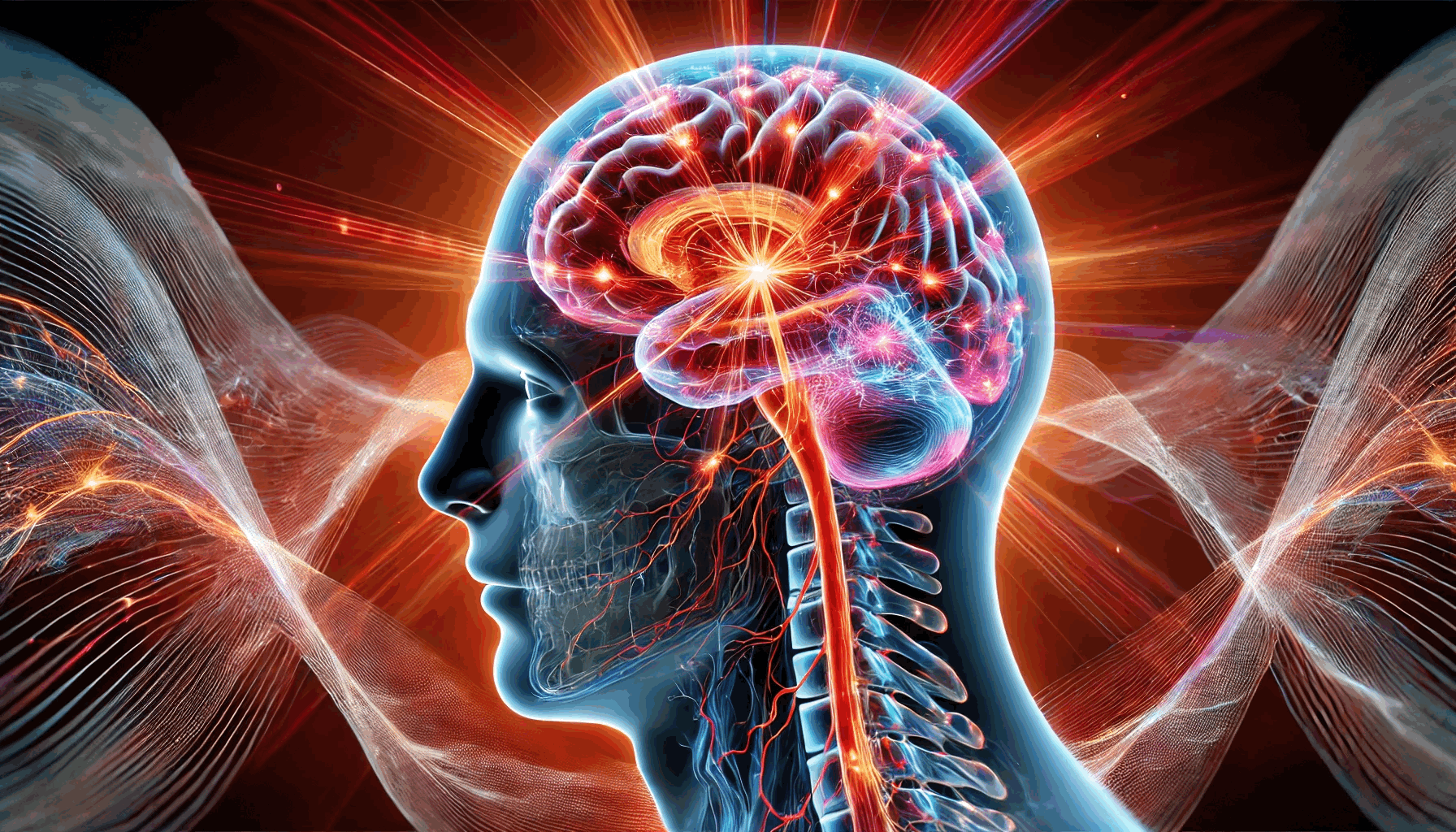
What if pain isn’t an error at all, but a form of intelligence—always learning, always adapting?
Pain doesn’t just arise from tissue damage. It comes from stories, memory, belief, and past experience. It works like an embodied AI system: collecting data, making predictions, guarding against threats. That’s the idea behind Regenerative Pain Theory: pain as a neural system shaped by information, not just injury.
The good news? Like any intelligent system, pain can be re-educated. Through trust, story, and guided movement, we can reshape how the body responds. Pain isn’t a punishment. It’s protection gone too far. And that means it can change.
Pain isn’t just a signal. It’s a storyteller, a learner, a protector. What if it wasn’t something broken—but something smart? In this piece, we introduce Regenerative Pain Theory: the idea that pain adapts like a neural network, shaped by meaning, memory, and past experience.
Unlike outdated models that see pain as damage, Regenerative Pain Theory views pain as a dynamic intelligence—not artificial, but embodied. It gathers data, makes predictions, and responds to patterns. The catch? If it learns the wrong story (like "movement is dangerous"), it can become overprotective.
But here’s the hope: just like AI, pain can be retrained. Through movement, trust, new narratives, and meaningful exposure, we can help the system adapt again—toward recovery, not retreat. Pain isn't a glitch. It's a form of biological intelligence waiting for a better story.